Article
Signs Your HVAC Needs Replacing Not Just Fixing
How to Know When Your HVAC Needs Replacing, Not Just Fixing
If you're noticing signs your HVAC needs replacing not just fixing, you're not alone — and catching them early can save you from a costly emergency on the hottest day of a Georgia summer. Most homeowners wait until the system stops working entirely before acting, but that reactive approach almost always costs more and leaves you with fewer options.
Here are the most common signs your HVAC system needs replacement rather than repair:
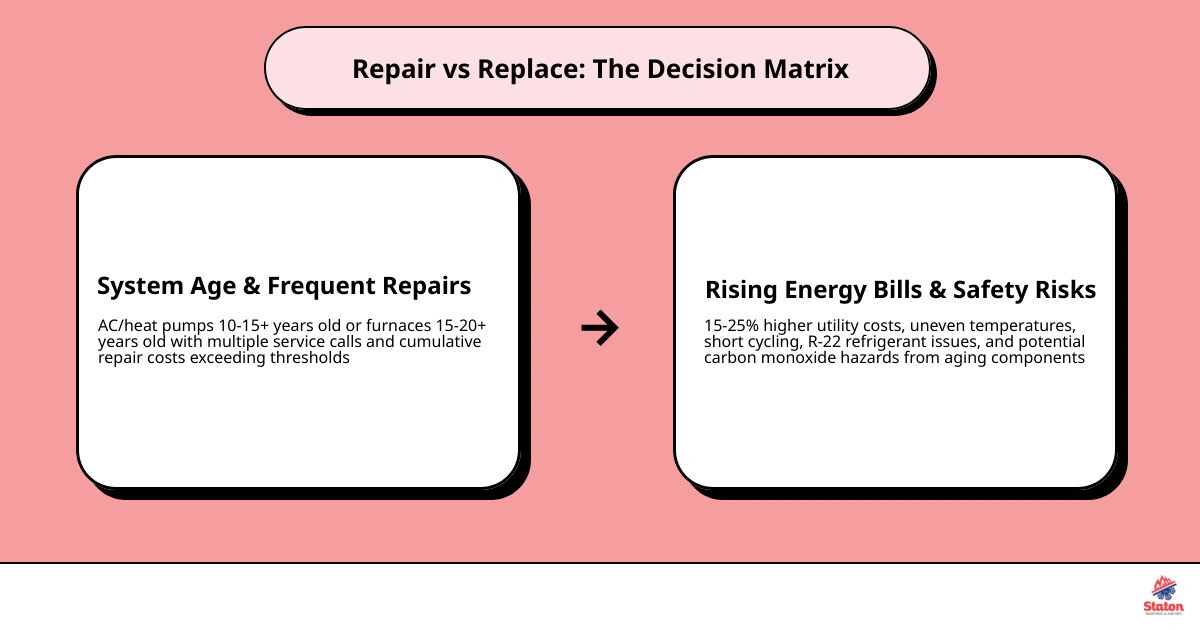
- System age: AC units and heat pumps over 10-15 years old; furnaces over 15-20 years old
- Rising energy bills: Unexplained increases of 15-25% or more without changes in usage
- Frequent repairs: Multiple service calls per year, or repair costs adding up fast
- The 50% rule: Any single repair that costs more than 50% of a new system's price
- R-22 refrigerant: Older systems using this phased-out refrigerant are expensive and difficult to service
- Uneven temperatures: Some rooms too hot, others too cold, despite thermostat adjustments
- Safety concerns: Yellow furnace flames, burning smells, or suspected carbon monoxide issues
- Short cycling or constant running: System turns on and off rapidly, or never fully shuts off
- Ice on coils or visible rust: Physical deterioration that points to deeper systemic failure
For Metro Atlanta homeowners in areas like Alpharetta, Kennesaw, and Dunwoody, where summers push systems hard for months at a time, these warning signs tend to show up faster than the national average — and ignoring them tends to be more expensive.
The sections below break down each of these signals in detail so you can make a confident, informed decision about whether to repair or replace your system.
The Age Factor: When Your System Reaches Its Golden Years
Just like any hard-working mechanical system, your heating and cooling equipment has a finite lifespan. While routine maintenance certainly keeps things spinning smoothly for longer, it cannot stop the march of time.
In our experience serving Metro Atlanta, we find that a central air conditioner or heat pump typically lasts between 10 and 15 years. Gas furnaces generally enjoy a slightly longer run, often lasting between 15 and 20 years before their performance declines sharply.
When your system crosses these age thresholds, components begin to wear down simultaneously. Fixing a single motor or capacitor might get you through the week, but it often acts as a temporary patch before the next part fails. If you are trying to decide if your unit is nearing its final days, it is highly beneficial to read about How Old Is Too Old for an HVAC System to put your equipment's age into perspective. Additionally, understanding When to Consider AC Replacement can help you plan your upgrade before a complete system failure leaves you stranded in the heat.
How to determine system age from the manufacturer label
If you did not live in your home when your current heating and cooling system was installed, you might not know exactly how old it is. Fortunately, your equipment carries its own birth certificate.
To find the age of your system:
- Locate the metal rating plate or sticker on the side of your outdoor AC condenser or on the front panel of your indoor furnace/air handler.
- Look for a line that explicitly states the "MFR DATE" or manufacture date.
- If the date is not clearly printed, locate the serial number. For most major brands, the first four digits of the serial number represent the week and the year the unit was manufactured. For example, a serial number starting with "1211" typically indicates the unit was built in the 12th week of 2011.
Why older systems struggle with Metro Atlanta summer heat waves
Summers in Georgia are notoriously brutal. In communities like Alpharetta and Milton, our systems must battle both high temperatures and oppressive humidity.
As an air conditioner ages, its internal components degrade. The compressor loses its compression efficiency, and the coils accumulate microscopic corrosion that hinders heat transfer. When a July heatwave strikes, an older system must run much longer and work significantly harder just to maintain basic comfort. This constant strain during peak weather is often the final straw that triggers a catastrophic breakdown.
Financial Red Flags and the 50% Rule
At some point, keeping an old HVAC system running becomes a case of throwing good money after bad. To help visualize this crossroad, consider how repair habits stack up against a fresh start:
| Decision Factor | Keep Repairing | Choose Replacement |
|---|---|---|
| System Age | Under 10 years old | Over 10–15 years old |
| Repair Frequency | Rare, isolated issues | 3+ repairs in the last 3 years |
| Single Repair Cost | Under 50% of new system cost | Over 50% of new system cost |
| Energy Efficiency | Stable or minor drops | Bills rising 15–25% with no usage change |
| Refrigerant Type | Modern R-410A or newer | Outdated R-22 (Freon) |
| Warranty Status | Parts covered under warranty | Warranty fully expired |
When evaluating these financial red flags, it helps to read our comprehensive breakdown on the Cost of Repairing Old HVAC vs Buying New System. This comparison can clarify whether you are dealing with a simple fix or a system ready for retirement. For a broader look at this dilemma, check out our guide on whether Should I Repair or Replace My HVAC System.
Applying the 50% rule and the $5,000 rule to repair bills
Two reliable financial rules can guide your decision: the 50% Rule and the $5,000 Rule.
The 50% Rule is straightforward: if a single repair estimate exceeds 50% of the cost of a brand-new system, replacement is almost always the smarter financial choice. Paying half the cost of a new system to patch up an old, out-of-warranty unit is a high-risk gamble, as other aging parts could fail shortly after.
The $5,000 Rule takes the age of your system into account. To apply it, multiply the cost of the recommended repair by the age of your system in years:
- Example A: A 6-year-old system needs a repair. $500 (repair cost) x 6 (years old) = $3,000. Since this is under the $5,000 threshold, repairing the unit is a reasonable choice.
- Example B: A 13-year-old system needs a major repair. $500 (repair cost) x 13 (years old) = $6,500. Because this exceeds the $5,000 threshold, investing in a replacement is the more cost-effective long-term move.
The compounding cost of frequent or major component repairs
While a single minor repair is easy to dismiss, frequent service calls add up quickly. If you find yourself on a first-name basis with your HVAC technician, you are caught in a "repair trap."
Major component failures are particularly strong indicators that replacement is necessary. Replacing a failed compressor, a cracked heat exchanger, or a leaking evaporator coil requires significant labor and expensive parts. Because these parts represent the heart of your system, their failure often indicates systemic wear that will soon trigger other issues. Recognizing these compounding expenses is one of the 6 Warning Signs That It's Time to Replace Your HVAC.
Performance and Comfort Signs Your HVAC Needs Replacing Not Just Fixing
An HVAC system's primary job is to keep your indoor environment comfortable and healthy. When a system is nearing the end of its life, it will struggle to maintain consistent temperatures and manage humidity, regardless of how often you adjust the thermostat.
If your home is experiencing persistent comfort issues, it is highly recommended to review the 3 Signs That It Is Time to Replace Your HVAC Unit.
Uneven temperatures and poor airflow across different rooms
Have you noticed that your living room feels like an icebox while your upstairs bedrooms feel like a sauna? Uneven heating and cooling often point to a failing blower motor, compromised ductwork, or a system that has lost its capacity to push air effectively through your home.
In Metro Atlanta cities like Kennesaw and Dunwoody, where homes often feature complex layouts or multiple levels, a weak system simply cannot distribute conditioned air evenly. Before assuming your equipment is the only culprit, it's also wise to check your control systems; read about the 7 Signs You Need to Replace Your Thermostat to rule out minor electrical or calibration issues.
Short cycling and constant running as signs your hvac needs replacing not just fixing
A healthy HVAC system runs in predictable, steady cycles to reach your desired temperature and then shuts off. Two extreme behaviors indicate a system in distress:
- Short Cycling: This occurs when your system turns on, runs for a few minutes, and abruptly shuts off before completing a full cycle, only to turn back on moments later. This rapid cycling puts immense wear on your compressor and fan motor, wasting energy and accelerating system failure.
- Constant Running: If your AC or furnace runs continuously without ever reaching your thermostat's set temperature, it has lost its heating or cooling capacity.
In communities like Peachtree Corners, this constant running during hot summer afternoons leads to high energy consumption and indicates that your system's major components are worn out.
Efficiency, Refrigerant, and Safety Triggers
Beyond comfort and high repair bills, there are critical efficiency, environmental, and safety issues that make replacing your HVAC system the only logical choice. If you suspect your system is failing on these fronts, learn How to Know When Your AC Needs to Be Replaced.
Rising energy bills and declining SEER2 efficiency ratings
Have you noticed your monthly power bills creeping upward, even though your family's daily habits haven't changed? This is a classic sign of declining efficiency.
Over a 10-to-15-year period, wear and tear can cause an older unit's operating efficiency to drop significantly. For example, an older system originally rated at 14 SEER may only perform at an 8 or 9 SEER level after years of component degradation, resulting in a 20-30% increase in energy consumption.
Upgrading to a modern, high-efficiency system can deliver up to 20% savings on heating and cooling costs. If you are replacing an exceptionally old 10-SEER system with a new 16-SEER unit, you can reduce your cooling energy consumption by approximately 37%, which translates to substantial annual savings.
Outdated R-22 refrigerant and safety risks as signs your hvac needs replacing not just fixing
If your air conditioner was manufactured before 2010, it likely relies on R-22 refrigerant (commonly known as Freon). To protect the ozone layer, the EPA phased out the production and import of R-22. Because of this, recycled R-22 can cost between $150 and $250 per pound at the customer level. If your older system develops a refrigerant leak, refilling it can cost over $1,000—a temporary fix that doesn't address the underlying leak.
Safety concerns are also paramount when evaluating older heating systems:
- Cracked Heat Exchanger: In a gas furnace, a cracked heat exchanger can allow toxic carbon monoxide (CO) gas to leak directly into your home's airstream. This is a severe health hazard and a critical safety risk.
- Yellow Furnace Flame: A healthy gas burner should produce a steady, bright blue flame. A yellow, flickering flame indicates incomplete combustion, which is a major warning sign of carbon monoxide production.
- Rust and Corrosion: Heavy rust on your furnace burners or AC coils can flake off, blocking airflow, causing electrical shorts, and creating potential fire hazards.
If your older system presents any of these safety risks, immediate replacement is the only safe option.
Frequently Asked Questions about HVAC Replacement
What is the best time of year to replace an HVAC system in Georgia?
The ideal times to replace your system are during the "shoulder seasons"—typically spring (March to May) and fall (September to November). During these months, the weather is mild, meaning you won't have to suffer through extreme heat or cold while your system is being swapped out. Additionally, because HVAC contractors are less busy with emergency repair calls during these periods, you'll enjoy more flexible scheduling.
Should I replace my furnace and AC at the same time?
While it is technically possible to replace only one half of your system, we almost always recommend replacing both the heating and cooling components together.
Modern HVAC components are designed to work as matched systems. Pairing a brand-new, high-efficiency outdoor AC unit with an old, inefficient indoor blower motor can prevent the new unit from reaching its rated efficiency. Replacing both units at once also saves on labor costs, ensures full warranty coverage, and prevents you from paying for a second installation service just a few years down the road.
Does a new HVAC system increase home value?
Absolutely. A new, energy-efficient HVAC system is a major selling point for potential buyers. It gives them peace of mind knowing they won't have to worry about an expensive mechanical failure or high utility bills immediately after moving in. To learn more about how this upgrade protects your equity, read about How a New HVAC System Increases Home Value.
Conclusion
Recognizing the signs your HVAC needs replacing not just fixing is the first step toward restoring safety, comfort, and financial predictability to your home. Rather than waiting for a complete system breakdown to force you into a rushed decision, taking a proactive approach allows you to explore your options and plan an upgrade on your own terms.
Since 1972, Staton Heating & Air Inc has provided trusted HVAC services to homeowners in Cumming, GA, and across Metro Atlanta. Our team of NATE-certified technicians is dedicated to finding the right solutions for your home, ensuring your comfort always comes first.
If your system is showing signs of wear, we can help you navigate the transition. We invite you to read our Step-by-Step Guide to the HVAC Replacement Process to learn what to expect during an upgrade.
Ready to get started? Schedule your professional HVAC evaluation today with our friendly team!
What Our Customers Are Saying



Have a comfort question?
Our family-owned team has answered them for over 50 years. Reach out anytime.
Get in touchFrom our family to yours
Ready for comfort done right?
Family-owned since 1972. Call now or book online — a real person is standing by to help.
Licensed & Insured · GA LIC# CU400373 · NATE Certified · 100% Satisfaction Guarantee