
Article
Heat Pump Advantages Over Traditional HVAC: Proven Efficiency
Why Heat Pump Advantages Over Traditional HVAC Matter for Atlanta Homeowners
The heat pump advantages over traditional HVAC systems are real, measurable, and increasingly hard to ignore — especially if you're a Metro Atlanta homeowner tired of running a separate furnace and air conditioner while watching energy bills climb every season.
Here's a quick look at how heat pumps stack up against traditional HVAC:
| Feature | Heat Pump | Traditional AC + Furnace |
|---|---|---|
| Heating & cooling | One system handles both | Two separate systems required |
| Heating efficiency | Up to 300% (moves heat, doesn't create it) | Gas furnace max ~98% |
| Annual energy savings | ~$370/year average; up to $1,000 from oil/propane | Varies by fuel type and usage |
| Carbon emissions | ~40% less CO2 than gas furnace | Higher with fossil fuel combustion |
| Cold weather performance | Modern models work to -20°F | Gas furnace maintains output in extreme cold |
| Maintenance | Twice yearly | Annual for furnace + annual for AC |
| Typical lifespan | 12–15 years | Furnace 18–20 yrs; AC ~15 yrs |
| Federal tax credit (2026) | Expired Dec 31, 2025 | N/A |
| State/utility rebates | Available in many states | Limited |
| Indoor air quality | No combustion; cleaner air | Gas combustion produces byproducts |
In a climate like Metro Atlanta's — hot, humid summers and relatively mild winters — heat pumps are especially well-suited. Georgia homeowners don't face the brutal subzero winters that make heat pumps struggle in northern states, which means you get to enjoy nearly all of the efficiency benefits with very few of the cold-weather drawbacks.
More than 5 million heat pumps were sold in the U.S. in 2026 alone, outselling traditional gas furnaces for the first time. That shift isn't a coincidence — it reflects a growing recognition that heat pump technology has matured into a genuinely superior choice for most homes in temperate and mild climates.
In this guide, Staton Heating & Air Inc walks you through everything you need to know: how heat pumps work, where they outperform traditional systems, what installation looks like for Georgia homes, and how to decide if upgrading makes sense for you.
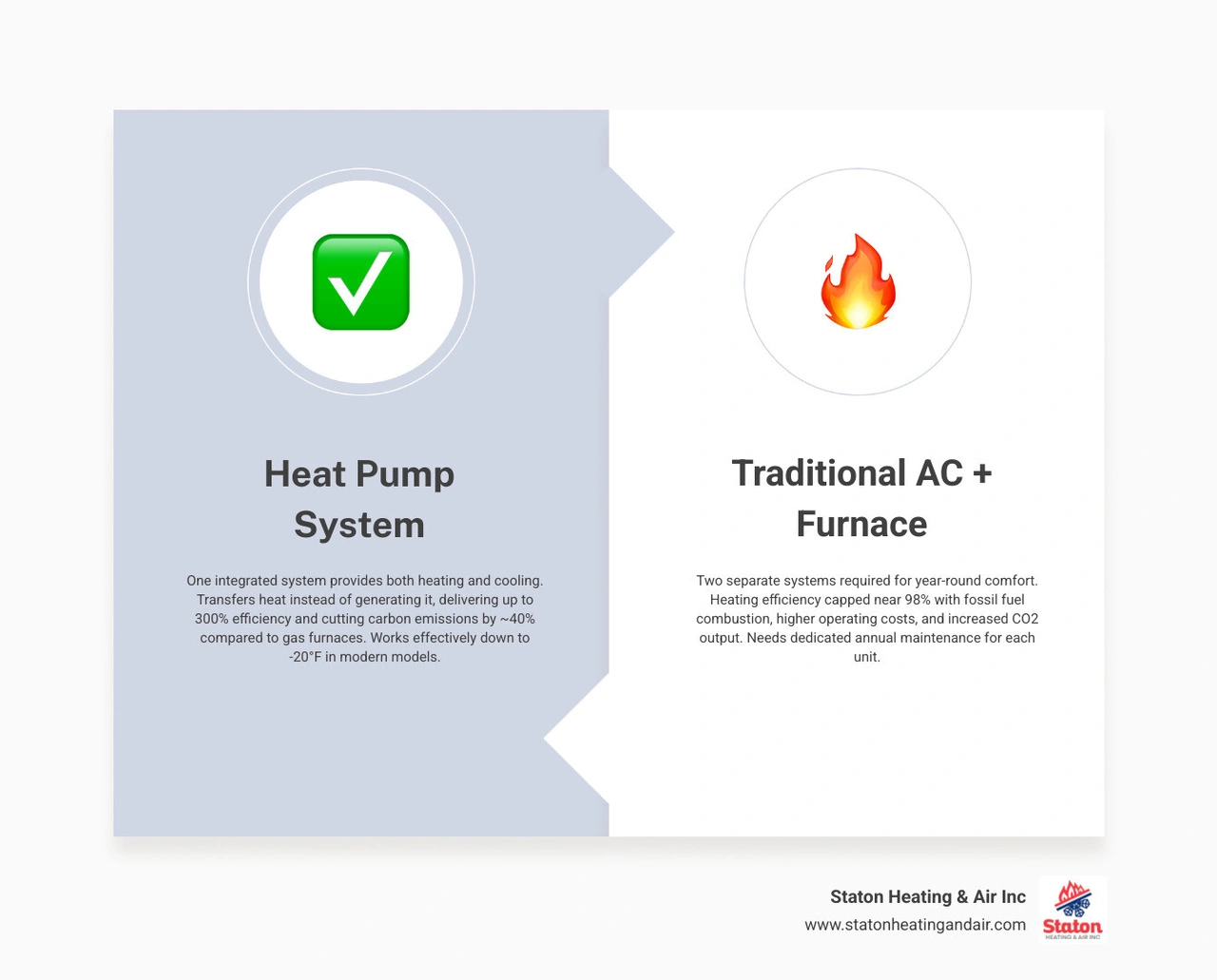
Important heat pump advantages over traditional hvac terms:
- are heat pumps ideal for humid subtropical climates
- heat pump benefits for georgia homeowners
- how does a heat pump work
What is a Heat Pump and How Does It Work?
To appreciate the heat pump advantages over traditional HVAC, it helps to understand that a heat pump is not actually a heater in the traditional sense. It does not generate heat through combustion (like a gas furnace) or through high-resistance electric coils (like a space heater). Instead, a heat pump is a heat transporter.
At its core, a heat pump uses the exact same refrigeration cycle as your kitchen refrigerator or a standard central air conditioner. It circulates refrigerant between an indoor coil and an outdoor coil, absorbing heat from one location and releasing it in another.
The magic lies in a component called the reversing valve. In the cooling cycle, the system extracts heat from your indoor air and dumps it outside, leaving your home cool and dry. When winter arrives, the reversing valve flips, reversing the refrigerant flow. The system then extracts thermal energy from the outdoor air—even when it feels cold outside—and pumps that heat indoors to warm your home.
Because it simply moves existing thermal energy from one place to another rather than creating it from scratch, a heat pump operates with incredible efficiency. To learn more about this mechanical process in detail, check out our guide on How Does a Heat Pump Work.
Heat Pump Advantages Over Traditional HVAC in Subtropical Climates
If you live in Metro Atlanta, you know that our summers are defined by heavy, muggy humidity. This is where variable-speed heat pumps truly shine. Traditional air conditioners often run at a single speed, cycling on and off in short bursts. This "short-cycling" cools the air quickly but doesn't run long enough to remove moisture, leaving your home feeling clammy.
Modern heat pumps, particularly those equipped with variable-speed inverter compressors, run continuously at lower, highly efficient speeds. This continuous operation allows the indoor evaporator coil to steadily pull moisture out of the air, significantly improving indoor comfort and managing latent heat load far better than older systems.
By keeping indoor humidity levels balanced, you can set your thermostat a few degrees higher in the summer while remaining completely comfortable. For an in-depth look at how this applies to our local climate, read our article exploring Are Heat Pumps Ideal for Humid Subtropical Climates.
Key Heat Pump Advantages Over Traditional HVAC
When comparing heating and cooling options, homeowners often look at comfort, operating costs, and environmental impact. Across all three categories, heat pumps present compelling advantages over older, combustion-based systems. For a broad overview of these benefits, see our post on the Advantages Investing in Heat Pump System.
Unmatched Energy Efficiency and Lower Carbon Emissions
The most significant advantage of a heat pump is its efficiency. A high-efficiency gas furnace maxes out at about 98% efficiency, meaning 2% of the fuel energy is lost through combustion fumes. Traditional electric resistance heating operates at a 1:1 ratio, or 100% efficiency.
A heat pump, however, routinely operates at a Coefficient of Performance (COP) of 3.0 to 4.0 under normal conditions. This means it delivers three to four times more heat energy than the electrical energy it consumes—representing an efficiency rate of 300% to 400%.
According to a collaborative study from the University of Texas, the University of Michigan, and Carnegie Mellon University, 98% of homes in the U.S. would reduce their carbon footprint by switching to a heat pump. On average, air-source heat pumps cut household carbon dioxide emissions by about 40% compared to standard gas furnaces. As the electrical grid continues to transition to cleaner energy sources, a heat pump-equipped home automatically becomes even cleaner over time.
Year-Round Comfort with a Single System
A traditional HVAC setup requires you to maintain two entirely different systems: a split-system air conditioner for the summer and a gas or oil furnace for the winter. This means two separate appliances taking up valuable square footage in your basement, attic, crawlspace, or utility closet.
A heat pump consolidates your heating and cooling into a single, streamlined outdoor unit paired with an indoor air handler. This dual functionality saves space and simplifies your home's infrastructure. Instead of managing separate maintenance schedules and different lifespans for two machines, you focus on keeping one cohesive system running at peak performance. For a comparison of system tiers, read our Standard Efficiency vs High Efficiency HVAC Comparison.
Comparing Long-Term Performance and Lifespan
Because a heat pump works year-round to provide both heating and cooling, it accumulates more operating hours than a standalone furnace or air conditioner. A standalone gas furnace might run for 4 to 5 months a year, while a standalone AC runs for another 4 to 5 months. A heat pump, by contrast, handles both duties, which naturally impacts its long-term durability.
On average, a well-maintained heat pump has a lifespan of 12 to 15 years. A dedicated gas furnace can sometimes last 15 to 20 years because it sits idle for half the year, while a standalone central air conditioner typically lasts around 15 years.
To offset the extra wear and tear of year-round operation, consistent professional maintenance is essential. If you are in the Metro Atlanta area, you can easily find local support by searching for Heat Pump Service Near Me Atlanta to keep your system operating at maximum efficiency.
Maintenance Requirements for Year-Round Operation
To ensure your heat pump achieves its full 15-year lifespan, you should establish a biannual maintenance routine:
- Spring Tune-Up: Performed before the heavy summer cooling season begins. Technicians check refrigerant levels, clean the outdoor condenser coils, inspect electrical connections, and verify clear condensate drains.
- Fall Tune-Up: Performed before the winter heating season. This check focuses on the reversing valve operation, auxiliary heating elements, defrost cycle controls, and indoor blower motor.
- Regular Filter Changes: Homeowners should replace air filters every 1 to 3 months. Clean filters ensure optimal airflow, which prevents the compressor from overworking and keeps your system running efficiently.
Cold Weather Performance and Dual-Fuel Options
A common concern among homeowners is whether heat pumps can handle freezing temperatures. Historically, older heat pumps struggled when temperatures dropped below 40°F, requiring inefficient electric backup "heat strips" to keep the home warm.
However, modern heat pump technology has advanced dramatically. Cold-climate heat pumps equipped with variable-speed inverter compressors and vapor-injection technology can maintain high efficiency at temperatures well below freezing, with some models operating effectively down to -20°F.
For homeowners who want the ultimate peace of mind during rare, extreme winter storms, a "dual-fuel" or hybrid system is an excellent option. This setup pairs an electric heat pump with a high-efficiency gas furnace. The heat pump handles all the heating during mild and moderately cold days, while the gas furnace automatically takes over only when temperatures drop past a certain freezing threshold.
How Heat Pump Advantages Over Traditional HVAC Hold Up in Georgia Winters
In Metro Atlanta areas like Cumming, Alpharetta, Johns Creek, and Marietta, winter temperatures rarely drop into the single digits. Our winter climate is characterized by mild to moderate cold, which is the absolute "sweet spot" for heat pump performance.
Because we rarely experience sustained subzero weather, a heat pump installed in Georgia will operate almost entirely within its peak efficiency range. This eliminates the need for expensive backup heating sources and allows local homeowners to maximize their utility savings. To learn more about how local weather patterns align with this technology, read our guide on Heat Pump Benefits for Georgia Homeowners.
Key Installation Considerations for Georgia Homeowners
If you're planning to upgrade your home's climate control system, there are several practical factors to review with a professional installer.

First, your existing ductwork must be evaluated. Heat pumps typically deliver air at slightly lower temperatures (90°F to 110°F) compared to the hot blasts of a gas furnace (120°F to 140°F). Because they move a larger volume of moderately warm air, your ducts must be properly sized and sealed to prevent whistling, restricted airflow, or energy loss.
Second, you must ensure your electrical panel has adequate capacity. Converting from gas heating to an all-electric heat pump may require upgrading your electrical service (for example, from a 100-amp panel to a 200-amp panel) to accommodate the outdoor compressor and potential auxiliary heat strips.
If your home lacks existing ductwork, ductless mini-split heat pumps are an exceptional alternative. They allow you to heat and cool individual zones or rooms independently without major renovations. Discover the advantages of these versatile systems in our guide to the Benefits of a Mini Split Heat Pump, and plan your project with our comprehensive Heat Pump Installation Alpharetta Guide.
Upgrading Your System in Metro Atlanta
When replacing an older HVAC system in homes across Suwanee, Duluth, Dunwoody, or Roswell, proper system sizing is critical. Installers should never simply replace your old unit with one of the exact same size without performing a Manual J load calculation. This calculation takes into account your home's square footage, insulation levels, window placement, and local climate data to determine the exact heating and cooling capacity your home requires.
An oversized system will cycle on and off too quickly, wasting energy and failing to dehumidify, while an undersized system will run constantly and fail to keep up on hot summer days. For local homeowners planning an upgrade, consult our Heat Pump Replacement Alpharetta GA Guide to ensure a seamless transition.
Frequently Asked Questions About Heat Pumps
Do heat pumps work well in freezing temperatures?
Yes, modern cold-climate heat pumps perform exceptionally well in freezing temperatures. While older models struggled below 40°F, current systems utilize advanced inverter compressors and vapor-injection technology to maintain full heating capacity down to 5°F, and can continue extracting heat from outdoor air down to -15°F or -20°F. In Georgia's mild winters, a standard heat pump will easily keep your home warm and comfortable without relying heavily on backup heating.
What incentives or tax credits are available for heat pumps in 2026?
As of 2026, the landscape for heat pump incentives has shifted. The federal Section 25C tax credit (which previously offered up to $2,000) expired on December 31, 2025, under the One Big Beautiful Bill Act. However, significant financial assistance remains available through state-level programs, such as the Home Electrification and Appliance Rebates (HEAR) program, which can provide substantial rebates for qualifying households.
Additionally, many local Georgia utility companies offer direct rebates for switching to high-efficiency heat pumps. To stay up to date on these changing opportunities, read our resource on Federal Tax Credits for Heat Pump Upgrades.
Is a heat pump quieter than a traditional air conditioner?
Yes. Older single-stage air conditioners and heat pumps made a loud clanging noise when cycling on and off. Modern variable-speed heat pumps are designed to run continuously at lower speeds, which significantly reduces operating noise. Premium inverter-driven models operate as quietly as 50 to 55 decibels—about the same sound level as a modern kitchen dishwasher—making them much quieter than traditional central AC units.
Conclusion
The heat pump advantages over traditional HVAC systems make them a smart, forward-thinking investment for homeowners throughout Metro Atlanta. By combining heating and cooling into a single, highly efficient system, you can lower your energy bills, reduce your carbon footprint, and enjoy superior humidity control during our long Georgia summers.
At Staton Heating & Air Inc, we have been providing expert HVAC services to Cumming, GA, and the surrounding Metro Atlanta communities since 1972. Our NATE-certified technicians are dedicated to quality workmanship and customer satisfaction—which is why we were named the Best HVAC Company in Cumming.
Whether you reside in Alpharetta, Milton, Kennesaw, Dunwoody, or Peachtree Corners, our team is ready to help you evaluate your home and choose the perfect system for your needs.
Ready to experience the comfort and savings of a modern heat pump? Schedule your consultation today with the local experts at Staton Heating & Air Inc.
What Our Customers Are Saying



Have a comfort question?
Our family-owned team has answered them for over 50 years. Reach out anytime.
Get in touchFrom our family to yours
Ready for comfort done right?
Family-owned since 1972. Call now or book online — a real person is standing by to help.
Licensed & Insured · GA LIC# CU400373 · NATE Certified · 100% Satisfaction Guarantee