Article
HVAC Replacement Return on Investment: Smart Atlanta Guide
Is HVAC Replacement Worth the Investment for Atlanta Homeowners?
HVAC replacement return on investment is one of the most important financial questions you can ask before committing to a new heating or cooling system. The short answer? Yes — it typically pays off, and often in more ways than one.
Here's a quick look at what most homeowners can expect:
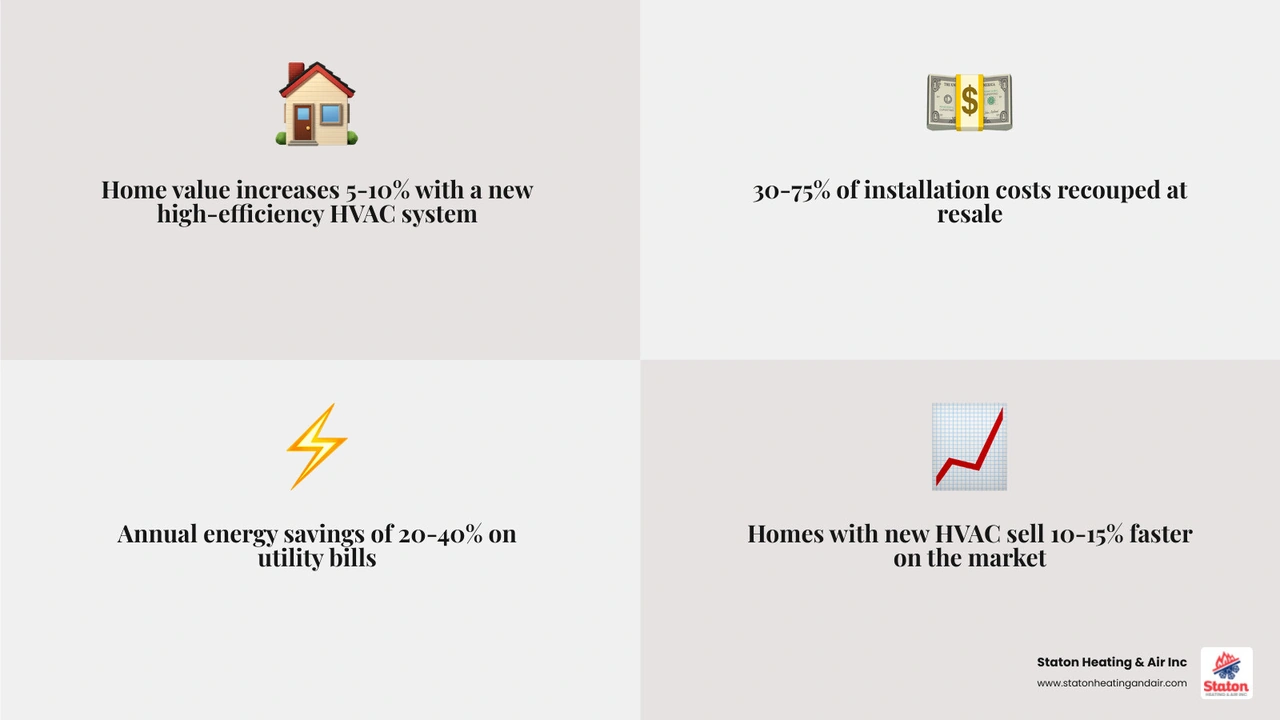
| ROI Factor | What to Expect |
|---|---|
| Home value increase | 5% to 10% added to your home's value |
| Cost recouped at resale | 30% to 75% of installation cost |
| Annual energy savings | 20% to 40% with a high-efficiency system |
| Typical payback period | 5 to 10 years through energy savings alone |
| Time on market | Homes with new HVAC sell 10–15% faster |
For Metro Atlanta homeowners in areas like Cumming, Alpharetta, and Kennesaw, those numbers matter. Georgia's hot, humid summers mean your HVAC system works hard — sometimes year-round. An aging, inefficient system doesn't just cost you in repair bills. It costs you every single month on your utility statement, and it can quietly chip away at your home's value when it comes time to sell.
Whether you're planning to stay put for years or thinking about listing soon, understanding the full picture of what a new system can return — financially and in daily comfort — is the smart first step.
Simple hvac replacement return on investment word guide:
How a New System Impacts Your Home's Resale Value

When real estate experts talk about home improvements, they often focus on high-visibility upgrades like custom kitchens or spa-like primary bathrooms. However, those cosmetic updates are highly subjective. A buyer might love your choice of quartz countertops, or they might plan to tear them out the day after closing.
An HVAC system, on the other hand, is what real estate professionals call a "defensive" or "functional" asset. It is a universal crowd-pleaser because every single buyer wants a home that stays cool in July and warm in January without costing a fortune to operate.
A new, professionally installed heating and cooling system increases your home’s appraisal value and significantly boosts buyer appeal. In the competitive Metro Atlanta real estate market—from the historic neighborhoods of Marietta to the rapidly growing communities in Woodstock and Milton—a brand-new HVAC system acts as a major selling point.
When potential buyers tour a home, one of the first questions they ask is, "How old is the HVAC?" If the answer is "less than a year old," it triggers an immediate sigh of relief. Buyers know they won't have to worry about an emergency replacement or expensive repair bills shortly after moving in. This peace of mind often prevents them from demanding steep seller concessions during the inspection phase. In fact, homes equipped with new climate control systems sell roughly 10% to 15% faster than comparable properties running on outdated equipment.
Furthermore, real estate appraisers look favorably on modern, high-efficiency systems. While a broken or ancient system can lead to a lower home appraisal, a newly upgraded unit ensures your property appraises at its maximum potential value, protecting your equity when it's time to close the deal.
For more detailed insights on how this investment translates to real estate success, read about how a new HVAC system increases home value and explore the answer to does a new HVAC help sell your home faster.
Calculating Your HVAC Replacement Return on Investment
To truly understand your hvac replacement return on investment, you have to look beyond resale value and examine your monthly utility bills. A high-efficiency HVAC upgrade pays you back every single month in energy savings.
Calculating your payback period involves comparing your current energy baseline to the projected consumption of your new system, while factoring in avoided repair costs. In Georgia, where hot and humid conditions dominate a large portion of the year, the savings from upgrading an old, inefficient system can be substantial.
To help visualize this, let’s look at how standard and high-efficiency systems compare across key payback factors:
| Payback Factor | Standard Efficiency System | High-Efficiency System |
|---|---|---|
| Upfront Premium | Baseline cost | Moderate premium |
| Annual Energy Savings | 10% to 15% reduction | 20% to 40% reduction |
| Typical Payback Period | 12 to 15 years | 5 to 10 years |
| Atlanta Climate Performance | Adequate comfort; runs longer cycles | Exceptional comfort; superior humidity control |
| Average Equipment Lifespan | 15 years | 15 to 20+ years (with proper maintenance) |
How Efficiency Ratings Impact HVAC Replacement Return on Investment
When shopping for a new system, you’ll encounter several key efficiency metrics:
- SEER2 (Seasonal Energy Efficiency Ratio 2): This measures the cooling efficiency of air conditioners and heat pumps. The higher the SEER2 rating, the less electricity the unit uses to cool your home. In our warm Georgia climate, upgrading from an old 10 SEER system to an 18+ SEER2 system can slash your summer cooling bills by up to 40%.
- AFUE (Annual Fuel Utilization Efficiency): This measures how efficiently a gas furnace converts fuel into heat. A standard furnace might have an 80% AFUE, meaning 20% of the fuel is lost as exhaust. A high-efficiency furnace can reach up to 96% to 98% AFUE, wasting almost no energy.
- HSPF2 (Heating Seasonal Performance Factor 2): This measures the heating efficiency of heat pumps.
One of the greatest contributors to a high ROI is variable-speed compressor technology. Unlike older systems that are either 100% "on" or completely "off" (which wastes incredible amounts of energy), variable-speed systems adjust their output dynamically. They run at lower, whisper-quiet speeds for longer periods. This continuous operation is incredibly efficient and allows the system to remove far more moisture from your indoor air. Because humid air feels warmer than dry air, excellent humidity control means you can set your thermostat a few degrees higher in the summer while remaining perfectly comfortable, saving even more on your monthly power bills.
Strategic Upgrades That Maximize HVAC Replacement Return on Investment
If you want to extract every bit of value from your new system, you should look at your home as a complete system. Pairing your HVAC replacement with strategic upgrades can prevent energy waste and maximize your financial return.
- Smart Thermostats: Installing a smart thermostat is one of the fastest ways to see a return. These devices learn your daily schedule and automatically adjust temperatures when you are asleep or away, saving an additional 10% to 15% annually on heating and cooling costs.
- Duct Sealing: The Department of Energy estimates that the average home loses 20% to 30% of its conditioned air through leaks and gaps in the ductwork. Sealing your ducts ensures that the air you pay to heat or cool actually reaches your living spaces.
- Insulation and Zoning Systems: Proper attic insulation keeps heat out in the summer and traps warmth in the winter, reducing the workload on your new system. Meanwhile, a zoning system allows you to direct comfort only to the rooms you are currently using, preventing you from wasting energy on empty spaces.
To make sure you get the most out of your upgrade, learn how to avoid these common mistakes and save money on your AC replacement.
Sizing, Professional Installation, and 2026 Incentives
Maximizing your ROI requires proper system sizing and flawless professional installation. A common mistake is installing an oversized system based on simple rules of thumb. An oversized unit will cycle on and off rapidly (short-cycling), which wears out the components prematurely, fails to remove humidity, and spikes your energy bills.
Our team uses precise ACCA Manual J load calculations to size your system perfectly, taking into account your home's square footage, window placement, insulation levels, and local climate.
Additionally, 2026 brings unique opportunities to lower your net investment. While some federal tax credits under the Inflation Reduction Act (like the Section 25C credits) have shifted or expired, various state-level programs—including High-Efficiency Electric Home Rebate Act (HEEHR/HEAR) programs—and local utility rebates remain highly active. These incentives can significantly lower your upfront costs, shortening your payback period.
To understand what to expect during your upgrade, check out our step-by-step guide to the HVAC replacement process.
When to Repair vs. Replace Your Atlanta HVAC System
At some point, keeping an aging system running costs you more than starting fresh with a new one. But how do you know when you've reached that tipping point?
To make an objective, emotion-free decision, we recommend using two industry-standard mathematical frameworks:
- The 50% Rule: If a single repair estimate costs more than 50% of the price of a brand-new system, replacement is almost always the smarter long-term financial decision.
- The $5,000 Rule (The Decision Score): Multiply the age of your system by the repair quote. If the result is over $5,000, it is time to replace. If it is under, a repair may still be a reasonable option.
For example, if a 12-year-old system needs a repair that costs $600, your score is $7,200 (12 x 600). Because this exceeds the $5,000 threshold, investing that money back into an aging machine is like putting brand-new tires on a shopping cart with a broken wheel.
Another critical factor is the type of refrigerant your system uses. If your system was installed before 2010, it likely runs on R-22 (Freon), which was phased out due to environmental regulations. Because R-22 is no longer produced or imported, recharging a system with a refrigerant leak has become incredibly expensive and impractical.
For a deeper dive into this decision, read our guides on should I repair or replace my HVAC system and compare the cost of repairing old HVAC vs buying new system.
Warning Signs of System Decline
Sometimes, your system doesn't break down completely; instead, it slowly drains your bank account through declining performance. Keep an eye out for these key warning signs:
- Frequent Breakdowns: If you have to call an HVAC technician more than once or twice a year, those "minor" repair bills are quickly adding up to the cost of a new system.
- Rising Utility Bills: If your energy bills are creeping upward even though your utility rates and habits haven't changed, your system is working harder and using more electricity to do the same job.
- Uneven Temperatures: Rooms that are constantly too hot or too cold indicate that your system is struggling to distribute conditioned air properly.
If you notice these issues, read more about the 6 warning signs that it's time to replace your HVAC and the 3 signs that it is time to replace your HVAC unit.
Key Considerations Before Upgrading
Before making your final decision, consider the overall equipment lifespan and warranty coverage. Standard central air conditioners and heat pumps typically last 10 to 15 years, while well-maintained gas furnaces can last 15 to 20 years. If your system is approaching the end of its expected lifespan, even a minor repair might just be delaying the inevitable.
Additionally, check if your current system is still covered under a manufacturer's parts warranty. If the warranty has expired, you will be responsible for the full cost of both parts and labor, making replacement much more attractive.
To help you weigh these factors, read our guides on how to know when your AC needs to be replaced and the top 10 considerations before deciding on air conditioner repairs or replacement.
Frequently Asked Questions about HVAC ROI
What is the typical payback period for a high-efficiency HVAC upgrade?
For most Metro Atlanta homeowners, a high-efficiency HVAC upgrade pays for itself through energy savings within 5 to 10 years. The exact timeline depends on your local utility rates, how well your home is insulated, and how much you utilize smart home technology. Because high-quality systems are built to last 15 to 20 years with regular maintenance, you can enjoy several years of pure financial savings after the system has completely paid for itself.
How much does a new HVAC system increase home resale value?
On average, a new HVAC system can increase a home’s resale value by 5% to 10%. Furthermore, homeowners typically recoup between 30% and 75% of the upfront installation costs at the time of resale. Perhaps more importantly, it makes your home highly marketable, helping it sell up to 15% faster and preventing buyers from asking for expensive price reductions during home inspections.
Is it worth replacing a 15-year-old system if it still works?
Yes, in many cases, preventative replacement of a 15-year-old system is highly beneficial. Systems of this age are operating on borrowed time and are significantly less efficient than modern 2026 models. By replacing the system proactively on your own terms, you can research the best deals, take advantage of seasonal rebates, and avoid the stress of an emergency breakdown on the hottest day of the summer.
Conclusion
Investing in a new heating and cooling system is one of the most reliable ways to improve your home's comfort, slash your monthly utility bills, and boost your overall property value. When you look at the big picture, the hvac replacement return on investment makes a lot of financial sense for Georgia homeowners.
At Staton Heating & Air Inc., we have been proudly serving Cumming, GA, and the surrounding Metro Atlanta communities—including Alpharetta, Johns Creek, Milton, and Suwanee—since 1972. Our philosophy is simple: "Where customers come first!" With our NATE-certified technicians, same-day service, and flexible financing options, we are dedicated to helping you find the perfect balance of comfort and long-term value.
Ready to see how much you could save? Schedule your professional HVAC assessment with Staton Heating & Air today, and let us help you maximize your home's financial and comfort potential!
What Our Customers Are Saying



Have a comfort question?
Our family-owned team has answered them for over 50 years. Reach out anytime.
Get in touchFrom our family to yours
Ready for comfort done right?
Family-owned since 1972. Call now or book online — a real person is standing by to help.
Licensed & Insured · GA LIC# CU400373 · NATE Certified · 100% Satisfaction Guarantee