
Article
How Smart AC Adapts to Your Lifestyle: 5 Smart Ways
Why How Smart AC Adapts to Your Lifestyle Is Changing Home Comfort in Metro Atlanta
How smart AC adapts to your lifestyle is one of the most practical upgrades a homeowner can make — especially during Georgia's long, punishing summers. Instead of manually adjusting a thermostat every few hours or coming home to a sweltering house, a smart AC system learns your schedule, responds to your habits, and keeps your home comfortable without constant input from you.
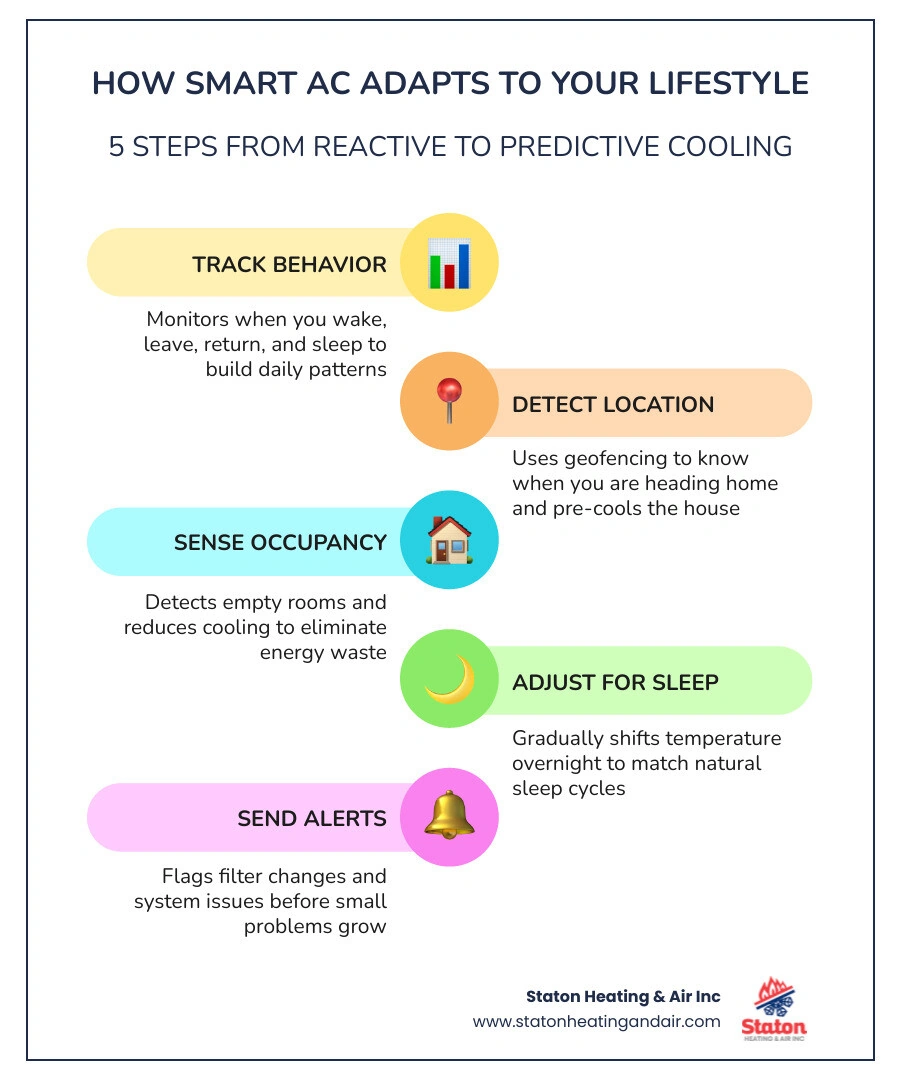
Here is a quick look at how smart AC systems adapt to your lifestyle:
- Learns your schedule — tracks when you wake up, leave, return, and sleep to automate temperature changes
- Uses geofencing — detects when you are heading home and starts cooling before you arrive
- Responds to occupancy — adjusts or powers down when rooms are empty to avoid wasting energy
- Adapts during sleep — gradually shifts to a sleep-friendly temperature without you touching anything
- Handles multiple people — manages different preferences across rooms using zone sensors
- Sends maintenance alerts — notifies you of filter changes or unusual system behavior before small issues grow
- Integrates with smart home devices — works alongside voice assistants, smart blinds, and lighting for seamless routines
The difference between a traditional AC and a smart one comes down to a simple idea: a traditional system reacts only when you tell it to. A smart system anticipates what you need and acts on its own. According to industry data, smart thermostats and AI-enabled AC controllers can reduce HVAC energy use by 10 to 23% annually — primarily by learning occupancy patterns and eliminating unnecessary runtime.
For homeowners in Metro Atlanta, where cooling costs can account for a significant portion of summer electricity bills, that kind of efficiency is not just convenient — it is genuinely valuable.
Understanding How Smart AC Adapts to Your Lifestyle
To truly understand how this technology shifts the paradigm of home comfort, we must look at the fundamental difference between traditional cooling and modern, adaptive systems. For decades, home climate control was entirely reactive. If you felt hot, you walked over to the wall and lowered the thermostat. If you left for work, you had to remember to turn the system down, or risk paying to cool an empty house all day.
Even standard programmable thermostats, which were a great step forward, have their limitations. They rely on rigid, pre-set timers. If your routine changes—say, you stay late at the office in Alpharetta or head out for a weekend trip to Lake Lanier—a traditional programmable thermostat continues running its schedule blindly.
Smart air conditioning systems change this completely. They transition your home from reactive cooling to predictive cooling. Instead of waiting for your manual input, a smart system actively observes your daily life, analyzes environmental factors, and makes micro-adjustments in real time. If you want to dive deeper into whether this upgrade makes sense for your household, you can read our detailed guide on Is Upgrading to a Smart AC System Worth It.
The Core Technology Behind How Smart AC Adapts to Your Lifestyle
The magic behind an adaptive climate system isn’t really magic at all; it is a combination of connected hardware and intelligent software working together.
- Wi-Fi Connectivity: By connecting to your home's wireless network, your smart AC or thermostat can communicate with your smartphone, access local weather reports, and receive over-the-air software updates.
- Machine Learning Algorithms: This is the brain of the system. Over your first couple of weeks of use, the system builds a behavioral model of your household. It notes what time you wake up, what temperature you prefer when you come home from work, and how often you adjust the settings.
- Environmental and Motion Sensors: Modern smart systems use built-in or remote sensors to track humidity, ambient outdoor temperatures, and physical occupancy.
By analyzing these three streams of data, the system stops treating thermal comfort as a static number. It understands that a 74-degree room in Dunwoody feels very different when the outdoor humidity is at 90% versus when it is a dry afternoon. To explore how these technical components directly translate into lower utility bills, check out our resource on Smart Thermostats and HVAC Efficiency.
Key Features That Power Adaptive Climate Control
When we install a smart climate system in a Metro Atlanta home, we aren't just giving the homeowner a digital screen. We are unlocking a suite of advanced features designed to blend seamlessly into their daily routine.
- Geofencing: This feature uses your smartphone’s GPS to establish a virtual boundary around your property (often around 100 meters to a few miles). When the last person leaves the geofenced area, the system automatically shifts to an energy-saving "Away" mode. When you cross that boundary on your commute back home to Woodstock or Kennesaw, the system triggers a pre-cooling cycle so your home is perfectly comfortable the moment you walk through the door.
- Occupancy Detection: Many smart thermostats and smart AC units utilize built-in motion and heat sensors. If no movement is detected in a room for a set threshold (typically 15 to 30 minutes), the system will automatically scale back its output, preventing you from wasting energy on empty spaces.
- Smart Scheduling: Instead of forcing you to program a complex 7-day schedule manually, adaptive systems build a schedule for you. If you consistently lower the temperature to 71 degrees at 9:00 PM on weeknights, the system learns this pattern and automates the adjustment.
How Smart AC Adapts to Your Lifestyle During Sleep and Away Hours
Our bodies naturally require different temperatures throughout the day, particularly when we sleep. Traditional systems often overcool homes at night, leading to unnecessary energy consumption and a chilly wake-up call.
A smart AC adapts to your sleep cycle by slowly raising the temperature by one or two degrees in micro-steps during the middle of the night, matching your body's natural metabolic cooldown. It then gently lowers the temperature back to your preferred waking setpoint just before your alarm goes off.
When you are away, the system optimizes for maximum savings without allowing the indoor environment to reach extreme levels that could harm pets or houseplants. For Dunwoody residents looking to master these settings, our guide on WiFi Thermostat Setup Dunwoody offers step-by-step best practices.
Managing Multi-Member Households and Varying Preferences
One of the greatest points of friction in any home is the "thermostat war." One family member is always too hot, while another is wrapped in a blanket.
Smart AC systems solve this behavioral problem through remote room sensors and advanced zoning capabilities. By placing small, wireless sensors in key areas like the master bedroom, the home office, or the basement playroom, the smart system can balance the climate based on where people are actually spending their time.
If you integrate these features with a broader home automation platform, you can create highly customized profiles for every member of the family. To see how these elements tie together under a unified smart home umbrella, explore our page on Nexia Home Automation Atlanta GA.
Real-World Benefits: Energy Savings and System Longevity
Upgrading to a smart climate system is more than just a luxury convenience; it is a highly practical financial investment. By optimizing when and how your compressor runs, these systems significantly reduce wear and tear on your HVAC equipment.
Preventing "short cycling" (when an AC turns on and off rapidly) and avoiding running the system at maximum capacity when no one is home can extend the overall lifespan of your unit by several years.
To put the differences in perspective, let’s look at how a smart learning thermostat compares to older technology:
| Feature | Traditional Programmable Thermostat | Smart Learning Thermostat |
|---|---|---|
| Schedule Creation | Manual, rigid time-block programming | Automatic, learns from your daily habits |
| Away Mode | Must be manually set or pre-programmed | Automatic via geofencing and motion sensors |
| Remote Access | None (must adjust physically at the wall) | Full control via smartphone, tablet, or voice |
| Weather Integration | None | Adjusts cooling cycles based on local humidity and heat |
| System Health Diagnostics | None | Sends alerts for filter changes and mechanical issues |
| Average Summer Savings | Minimal (if programmed incorrectly) | 15% to 25% on peak summer cooling costs |
Additionally, smart apps provide detailed energy usage dashboards. Instead of wondering why your electric bill was high last month, you can look at visual data showing exactly how many hours your system ran and what triggered those cycles. To learn more about the financial returns of these systems, read our article Is a Smart AC System Worth the Investment.
Choosing and Setting Up Your Smart Climate System in Metro Atlanta
Choosing the right smart AC or thermostat depends heavily on your home’s layout, your existing HVAC configuration, and your lifestyle. If you live in an older, historic home in Marietta or Roswell, your wiring might require a different approach (such as installing a C-wire adapter) compared to a newly constructed home in Cumming.
When setting up your system, proper placement is critical. A smart thermostat should always be installed on an interior wall, away from direct sunlight, drafty windows, or air registers. If placed incorrectly, the sensors will read false temperatures, causing your system to run longer than necessary or shut off prematurely. For professional assistance with this process, you can reach out to our team for Smart Thermostat Installation Atlanta.
Professional Integration and Local Climate Demands
While DIY smart thermostats are widely available, professional installation ensures that your new smart controls are perfectly calibrated to your specific heating and cooling equipment. This is particularly important in North Georgia, where our systems must transition seamlessly from humid, 95-degree summer days to freezing winter nights.
Our NATE-certified technicians understand the local climate demands of communities like Alpharetta, Milton, and Johns Creek. We can help you configure advanced settings, such as pairing your smart thermostat with a whole-home dehumidifier or setting up multi-zone cooling.
If you already have a high-efficiency system, such as a Trane unit, proper configuration is essential to unlock its full potential. Learn more by reading our guides on How to Program a Trane Thermostat and our dedicated Programmable Thermostat Service Cumming.
Frequently Asked Questions About Smart AC Adaptation
How does a smart AC learn my daily routine?
A smart AC or thermostat learns your routine through behavioral tracking. During the first week or two after installation, it monitors when you make manual temperature adjustments, combines this with data from its occupancy sensors, and recognizes recurring patterns. Over time, it builds a personalized comfort profile and automates those adjustments for you.
Can a smart AC really lower my summer electricity bills in Georgia?
Yes. By utilizing features like geofencing and occupancy detection, smart systems ensure you aren't paying to cool an empty house. During our peak summer months in Georgia, homeowners using smart climate controls report average monthly cooling bill savings of 15% to 25%.
Do I need to replace my entire HVAC system to get smart features?
Not at all. Most standard central split systems and heat pumps can be retrofitted with a smart thermostat. If you have ductless mini-splits or window units, you can use smart IR controllers to convert your existing system into an intelligent, Wi-Fi-enabled setup without replacing any major equipment.
Conclusion
Embracing a smart climate system is about much more than adopting the latest gadget—it is about removing daily friction and letting your home work for you. By understanding how smart ac adapts to your lifestyle, you can enjoy consistent comfort, lower energy bills, and a longer lifespan for your heating and air conditioning system.
Since 1972, Staton Heating & Air Inc has been keeping families comfortable across Cumming, Alpharetta, Milton, and the broader Metro Atlanta area. As NATE-certified professionals and the proud recipients of the Best HVAC Company in Cumming award, we are here to help you design, install, and maintain the perfect smart climate setup for your home.
Ready to make the switch to an intelligent cooling system? Upgrade to a Smart AC System Today with the local experts who always put your comfort first!
What Our Customers Are Saying



Have a comfort question?
Our family-owned team has answered them for over 50 years. Reach out anytime.
Get in touchFrom our family to yours
Ready for comfort done right?
Family-owned since 1972. Call now or book online — a real person is standing by to help.
Licensed & Insured · GA LIC# CU400373 · NATE Certified · 100% Satisfaction Guarantee