Article
Smart AC Pros and Cons for Homeowners Essential Guide
Smart AC Pros and Cons for Homeowners in Metro Atlanta: What You Need to Know
Understanding the smart AC pros and cons for homeowners is one of the most important steps you can take before deciding whether to upgrade your cooling system — especially in a climate like Metro Atlanta's, where your AC runs hard for months at a time. Smart AC systems promise lower energy bills, remote control from your phone, and smarter automation. But they also come with real trade-offs around cost, internet dependency, and compatibility with older equipment.
Here's a quick breakdown so you can size up the decision fast:
Smart AC Pros:
- Control your AC from anywhere using a smartphone app
- Save an average of 8–15% on energy bills annually (EPA data)
- Geofencing automatically adjusts temperature when you leave or return home
- Predictive maintenance alerts can prevent costly breakdowns
- Integrates with voice assistants like Alexa and Google Assistant
- Inverter technology can reduce electricity use by 30–50% vs. conventional systems
Smart AC Cons:
- Higher upfront cost than a standard AC system
- Requires a stable Wi-Fi connection for smart features to work
- May not be compatible with older HVAC systems (especially those without a C-wire)
- Adds complexity — setup and troubleshooting take more effort
- Connected devices raise privacy and cybersecurity concerns
- 29% of smart thermostat owners never use the scheduling features they pay for
The honest truth? Smart ACs are a strong investment for the right home — but they're not a universal upgrade for every situation. Keep reading for the full breakdown.
Glossary for smart ac pros and cons for homeowners:
What is a Smart AC System and How Does It Work?
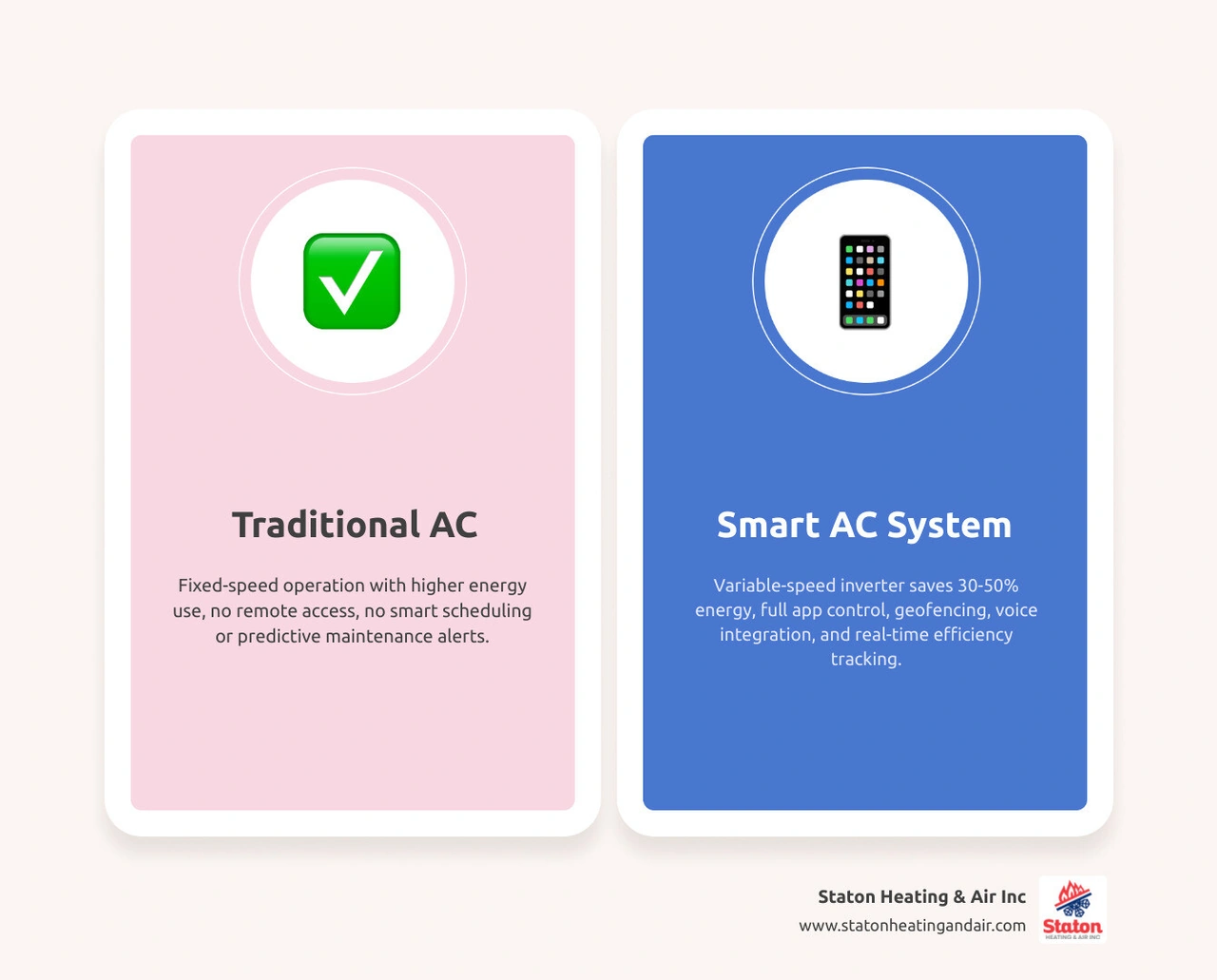
To understand how a smart AC system works, it helps to look at what traditional air conditioners lack. A standard AC is a relatively simple machine: it reads the temperature in one central hallway, and when that spot gets too warm, it kicks on at 100% capacity until the target temperature is met. It cannot learn your habits, track your energy use, or adjust itself when you leave the house.
A smart HVAC system, on the other hand, relies on advanced internet connectivity (usually via your home's Wi-Fi network), specialized sensors, and advanced software to optimize your home comfort. Instead of relying on manual adjustments, a smart AC system can be controlled through a smartphone app, tablet, or smart home hub.
Many modern smart AC systems utilize variable-speed inverter technology. Unlike conventional compressors that only run at "all on" or "all off," inverter-driven compressors can adjust their speed dynamically. They run continuously at lower, ultra-efficient speeds to maintain a perfectly consistent temperature.
When you pair this advanced hardware with smart programming, the system can:
- Track your daily routines and automatically adjust settings.
- Monitor outdoor weather conditions to pre-cool or pre-warm your home.
- Gather detailed energy usage data so you can see exactly when and where you are consuming power.
- Send predictive diagnostics and maintenance reminders directly to your phone.
If you are wondering whether making this transition makes sense for your property, you can read more about the core differences in our guide on Is Upgrading to a Smart AC System Worth It.
The Smart AC Pros and Cons for Homeowners: The Advantages

When homeowners in areas like Alpharetta, Milton, and Suwanee look into upgrading their cooling, the potential benefits are usually what spark their interest first. Let's look at the primary advantages that make these systems so popular.
First and foremost is energy efficiency. Traditional air conditioners consume a massive amount of electricity, often accounting for a huge portion of your summer utility bills. Smart AC systems can reduce energy consumption by 20% to 40% compared to traditional units when configured properly. By using variable-speed inverter compressors and smart scheduling, the system avoids the energy-intensive "on-and-off" cycling of older models.
Another major advantage is remote access and geofencing. Have you ever left your home in Kennesaw or Woodstock for a weekend trip, only to realize halfway down the highway that you left the AC blasting at 68 degrees? With a smart AC, you can pull up an app on your phone and adjust the temperature in seconds. Even better, geofencing features use your phone's GPS location to detect when you leave a certain radius around your home, automatically shifting the system into an eco-friendly "away" mode and cooling the house back down just as you return.
Predictive maintenance is another silent money-saver. Consumer Reports data shows that approximately 19% of central AC systems encounter at least one problem over their lifespan, with 24% of those units failing completely. Smart HVAC systems monitor their own operating parameters. If they detect a drop in airflow or a struggle in the compressor, they can send an alert to your phone before a complete breakdown occurs. This allows you to schedule a quick repair rather than facing a complete system failure on a hot July afternoon.
To see a detailed breakdown of how these features translate to real-world savings, check out our article on How Much Does Smart AC Technology Save on Bills.
Weighing the Smart AC Pros and Cons for Homeowners: Convenience and Comfort
Beyond the raw financial savings, the daily experience of living with a smart AC system is a major selling point. Customized scheduling allows you to program your cooling around your exact lifestyle. You can set the system to keep things cool while you sleep, gradually raise the temperature while you are at work, and bring it back down right before you walk through the door.
Voice control and smart home integration take this convenience a step further. If you are tucked into bed or relaxing on the couch in Dunwoody, you don't have to get up to adjust the thermostat. A simple voice command to Amazon Alexa, Google Assistant, or Apple HomeKit is all it takes to adjust the temperature.
Many smart systems also feature learning capabilities. Over the course of a few weeks, they study when you manually adjust the temperature and begin automating those changes for you, adapting seamlessly to seasonal shifts. To learn more about how to connect these systems to your existing devices, read our article on How Smart AC Integrates with Your Home Automation.
Environmental and Efficiency Benefits of Smart Cooling
If reducing your environmental footprint is a priority, smart cooling is one of the most impactful upgrades you can make. Because smart systems optimize runtime and rely heavily on high-efficiency inverter technology, they significantly reduce your home's overall carbon emissions.
According to EPA data, smart thermostats that meet Energy Star criteria save users an average of 8% on their annual utility bills. In extreme climates or during hot Georgia summers, those savings can climb even higher. By using advanced algorithms to prevent overcooling and utilizing eco-modes when the home is empty, smart systems ensure that no energy is wasted. You can explore the relationship between hardware and environmental impact further in our guide on Smart Thermostats and HVAC Efficiency.
The Drawbacks: What to Consider Before Upgrading
While the benefits are impressive, a balanced look at the smart ac pros and cons for homeowners requires analyzing the disadvantages. Smart technology is not without its hurdles.
The most obvious drawback is the upfront investment. Smart AC systems, particularly those with variable-speed inverter compressors and zoning capabilities, carry a higher initial cost than basic single-stage systems. While they do pay for themselves over time through lower monthly utility bills, the initial cost can be a barrier for some homeowners.
Another critical factor is internet dependency. Smart AC features rely entirely on a stable, continuous Wi-Fi connection. If your internet router goes offline, or if you live in an area of Metro Atlanta prone to frequent connection drops, you lose access to app controls, voice commands, and automated geofencing. While the AC will still function using a physical remote or wall control, the "smart" features will be temporarily disabled.
Complexity is also a hurdle. For some homeowners, navigating smartphone apps, configuring automation rules, and linking multiple smart home devices can feel overwhelming. In fact, industry data reveals that 29% of programmable thermostat owners do not take advantage of scheduling features simply because they find the setup process too complicated.
Finally, privacy and cybersecurity are modern concerns. Any device connected to the internet carries a small risk of being targeted by hackers or experiencing data collection issues. It is important to buy from reputable manufacturers who provide regular security updates and to secure your home Wi-Fi network properly.
Analyzing Smart AC Pros and Cons for Homeowners: Compatibility and Installation
One of the most common issues homeowners face when upgrading is system compatibility. Many older HVAC systems do not support smart thermostats because they lack a "C-wire" (common wire), which provides continuous electrical power to the smart device's color screen and Wi-Fi chip.
If you live in an older home in Marietta, Canton, or Roswell, installing a smart thermostat may require running new low-voltage wiring through your walls or installing a specialized power adapter. Additionally, attempting a DIY installation on a complex, multi-stage or zoned HVAC system can easily lead to wiring errors, blown fuses, or even voiding your manufacturer's warranty.
To ensure your system is compatible and installed safely, professional assistance is highly recommended. You can learn more about what this process looks like by reading our guide on Smart Thermostat Installation Atlanta.
Smart AC vs. Normal AC: Which is Right for Your Metro Atlanta Home?
If you want the benefits of smart technology but are not ready to replace your entire heating and cooling system, you have options. You can choose to install a brand-new, native smart AC system, or you can retrofit your existing standard AC by adding an aftermarket smart thermostat or a smart AC controller (such as an infrared-based smart controller for ductless mini-splits).
Here is a comparison to help you weigh your options:
| Feature | Native Smart AC System | Normal AC + Smart Thermostat / Controller | Traditional Normal AC |
|---|---|---|---|
| Upfront Cost | High | Low to Moderate | Standard |
| Cooling Technology | Variable-speed inverter (highly efficient) | Depends on existing unit (usually single/two-stage) | Single-stage or two-stage |
| App & Voice Control | Built-in | Added via smart device | None (standard remote/dial) |
| Geofencing & Scheduling | Seamlessly integrated | Highly functional | None |
| Predictive Diagnostics | Advanced (monitors internal components) | Limited (monitors run times only) | None |
| Best For | Homeowners replacing an old system | Homeowners with a working, modern AC | Budget-conscious or manual control lovers |
If your current air conditioner is less than five years old and running reliably, retrofitting it with a smart thermostat is often the most sensible path. However, if your existing AC is aging, requiring frequent repairs, or causing your summer power bills to skyrocket, investing in a complete smart system upgrade will provide the greatest long-term return on investment.
To help you decide which path fits your budget and comfort goals, read our deep dive: Is a Smart AC System Worth the Investment.
Frequently Asked Questions about Smart AC Systems
Do smart AC systems actually save money on utility bills?
Yes. On average, EPA-certified smart thermostats save homeowners about 8% on their heating and cooling bills. When combined with a high-efficiency inverter-driven air conditioner, total energy savings can range from 20% to 40% compared to running an older, traditional single-stage system. The exact savings depend on your climate, how well your home is insulated, and how engaged you are with using the system's energy-saving features.
Can I make my existing normal AC smart without replacing it?
Yes! If you have a central ducted system, you can usually replace your old wall thermostat with a smart thermostat. If you use a ductless mini-split or a window unit that relies on an infrared remote control, you can purchase an aftermarket smart AC controller. These plug-in controllers act as a bridge between your home Wi-Fi and the AC's infrared receiver, giving you app control, scheduling, and smart integrations.
What happens to my smart AC if the internet goes down?
If your Wi-Fi or internet connection drops, your air conditioner will still keep your home cool. You will temporarily lose the ability to control the system via your phone app, voice assistants, or smart home automations. However, you can still adjust the temperature manually using the physical buttons on your wall thermostat or the system's physical remote control. Once your internet connection is restored, the smart features will automatically reconnect.
Conclusion
Upgrading your home comfort system is a major decision. When weighing the smart ac pros and cons for homeowners, it is clear that while smart systems require a higher initial investment and a stable internet connection, the benefits of lower energy bills, remote convenience, and predictive maintenance are incredibly compelling.
At Staton Heating & Air Inc, we have been helping Metro Atlanta families stay comfortable since 1972. Our NATE-certified technicians are experts in smart HVAC systems, zoning, and smart thermostat integration. Whether you are in Cumming, Alpharetta, Johns Creek, or Suwanee, we are dedicated to finding the perfect, high-efficiency cooling solution for your home.
Ready to take control of your energy bills and experience a new level of home comfort? Schedule your smart AC consultation with Staton Heating & Air today
What Our Customers Are Saying



Have a comfort question?
Our family-owned team has answered them for over 50 years. Reach out anytime.
Get in touchFrom our family to yours
Ready for comfort done right?
Family-owned since 1972. Call now or book online — a real person is standing by to help.
Licensed & Insured · GA LIC# CU400373 · NATE Certified · 100% Satisfaction Guarantee