Article
Ultimate Checklist: When to Repair vs Replace Your HVAC System
Is It Time to Fix or Replace Your HVAC System? Here's How to Know Fast
Knowing when to repair vs replace your HVAC system can save you from throwing money at a unit that's already on its way out — or replacing a system that still has years of reliable service left. For homeowners across Metro Atlanta, that decision often hits at the worst possible moment: the middle of a Georgia summer when your AC stops cooling, or on a cold January night when your furnace won't kick on.
Here's a quick answer to help you decide right now:
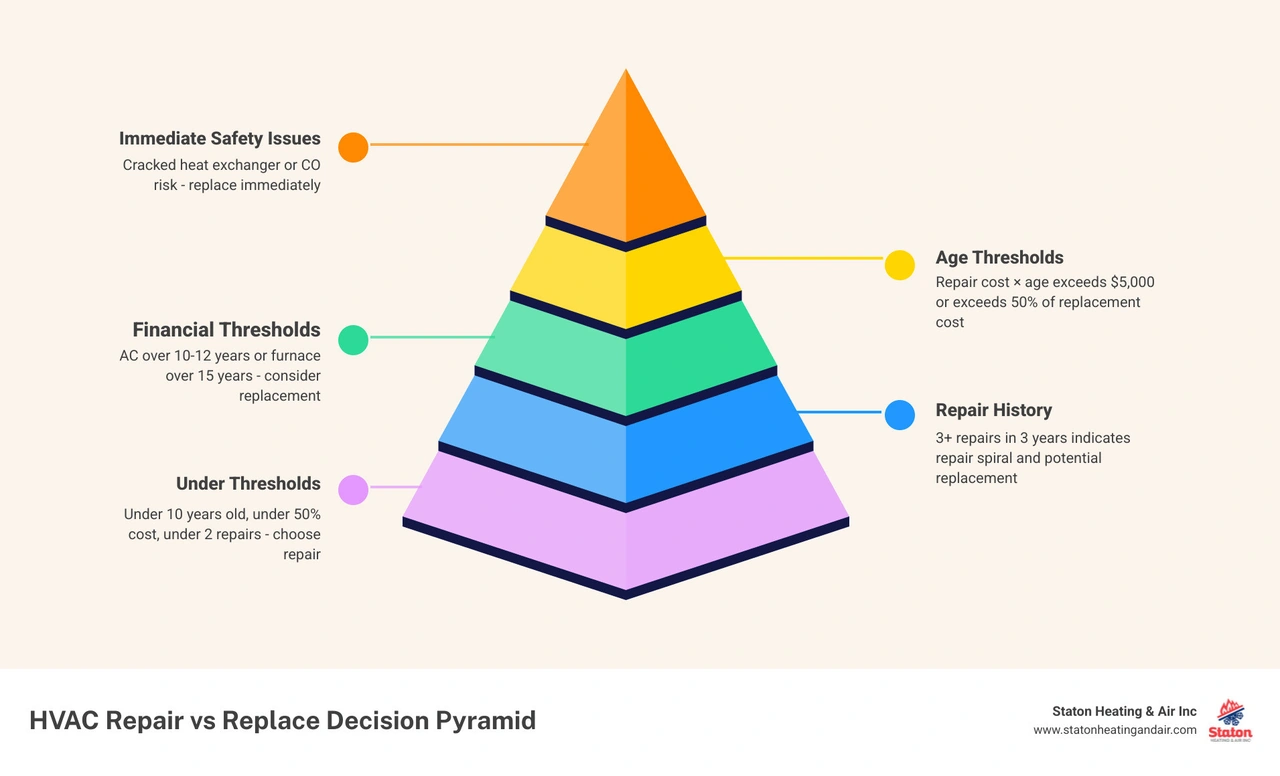
Repair your HVAC system if:
- The system is less than 10 years old (AC/heat pump) or less than 15 years old (furnace)
- The repair cost multiplied by the system's age is under $5,000
- The repair cost is less than 50% of what a new system would cost
- You've had no more than one or two repairs in the past three years
- The unit is still under warranty
Replace your HVAC system if:
- Your AC or heat pump is over 10–12 years old, or your furnace is over 15 years old
- The repair cost × system age exceeds $5,000
- The repair would cost more than 50% of a new system
- You've had three or more repairs in the last three years
- The system uses R-22 refrigerant
- A cracked heat exchanger or carbon monoxide risk has been detected
Most homeowners face this decision without much warning. A system that seemed fine last season suddenly needs an expensive fix — and it's hard to know whether paying for that repair makes sense or whether the smarter move is to put that money toward something new. The good news is there are clear, practical rules you can apply to make a confident, financially sound decision. This guide walks you through all of them.
Financial Rules of Thumb: When to Repair vs Replace Your HVAC System
When your heating or cooling system acts up, your first instinct is probably to look at your bank account. That is completely normal! To take the guesswork out of the equation, the HVAC industry relies on two primary financial formulas to determine whether a system is worth saving.
Evaluating the financial health of your system before signing off on a major fix is crucial. For a deeper dive into these initial steps, you can read our detailed guide on how to evaluate Should I Repair or Replace My HVAC System.
| Financial Rule | Formula / Scenario | When to Repair | When to Replace |
|---|---|---|---|
| The $5,000 Rule | System Age × Repair Cost | Total is under 5,000 | Total is 5,000 or higher |
| The 50% Rule | Cost of Repair vs. Cost of New System | Repair is under 50% of replacement cost | Repair is 50% or more of replacement cost |
The $5,000 Rule Explained
The $5,000 rule is a simple mathematical gut-check used by technicians and homeowners alike. To use it, you multiply the exact age of your system by the repair quote you received.
- The Formula:
Age of System (Years) × Cost of Repair = Score
If the resulting score is under 5,000, go ahead and repair the system. If the score is 5,000 or higher, your money is better spent on a replacement.
For example, let's say you have a 4-year-old air conditioner in Alpharetta that needs a moderate repair. Even if the repair is slightly higher, multiplying that cost by 4 will keep your score well under 5,000. Repairing is the clear winner here.
However, if you have a 12-year-old system in Marietta facing that exact same repair cost, your score immediately leaps over the 5,000 threshold. In this scenario, investing in a aging system that is already near the end of its typical lifespan is a financial gamble.
The 50% Rule for Major Component Failures
The 50% rule is even more straightforward: if a repair quote costs 50% or more of what it would cost to install a brand-new system, you should replace it.
This rule is particularly relevant when dealing with catastrophic failures of primary components, such as a cracked furnace heat exchanger or a seized AC compressor. These major components require intensive labor and expensive parts. If your warranty has expired, paying to fix a major component on a system that is already showing its age rarely makes sense.
When you are facing these high-stakes decisions, it helps to understand the specific mechanics behind AC Troubles: Repair or Replace to avoid sinking money into a sinking ship.
Evaluating System Age and Performance Indicators
While financial formulas are incredibly helpful, they don't tell the whole story. You also have to look at the physical reality of your system. How old is it really, and how has it been performing during those intense Georgia summer heatwaves?
The local climate in Metro Atlanta places a heavy burden on cooling systems. An air conditioner in Roswell or Smyrna has to work much harder than one in a milder climate, which can accelerate wear and tear. To understand how time affects your equipment, check out our guide on How Old Is Too Old for an HVAC System.
System Age: When to Repair vs Replace Your HVAC System
Different types of HVAC equipment age at different rates. In our June 2026 climate, here are the typical lifespans you can expect from well-maintained residential systems:
- Central Air Conditioners: 12 to 15 years
- Gas Furnaces: 15 to 20 years
- Heat Pumps: 12 to 18 years
Because heat pumps provide both heating and cooling, they run year-round, which can shorten their lifespan compared to a dedicated furnace that rests all summer. If your AC is pushing 12 years or your furnace is approaching 17 years, even minor issues are warning signs that the end is near. For more details on these timeline milestones, check out the 3 Signs That It Is Time to Replace Your HVAC Unit.
Frequency of Repairs and the "Repair Spiral"
Have you found yourself on a first-name basis with your HVAC technician lately? That is a classic indicator of the "repair spiral."
A good rule of thumb is the three-year rule: if your system has required three or more professional repairs in the last three years, it is telling you that its components are failing systematically. You might pay to fix a capacitor this month, only for the fan motor to fail next month, followed by a refrigerant leak the following season.
These compounding costs quickly add up to the cost of a new system, but without any of the reliability or warranty protection. If you are constantly patching up your system, look over these 6 Warning Signs That It's Time to Replace Your HVAC to see if your system fits the pattern.
Efficiency, Environmental Factors, and Safety Red Flags
As we navigate 2026, the technology behind home comfort is vastly superior to what was available 10 or 15 years ago. Upgrading your system isn't just about avoiding repairs; it's also about lowering your monthly utility bills and protecting your family's health.
If you are trying to weigh the long-term savings of a modern unit against the short-term cost of a fix, read our analysis on whether 7 Signs Your Air Conditioner Needs Replacement applies to your home.
Efficiency and Environmental Factors: When to Repair vs Replace Your HVAC System
Older HVAC systems are energy hogs. If your system was installed over a decade ago, it likely operates on outdated efficiency standards:
- SEER2 (Seasonal Energy Efficiency Ratio): Modern air conditioners boast SEER2 ratings ranging from 13 to over 22. Older units often operate at a SEER rating of 8 or 10. Upgrading from a SEER 9 to a modern SEER2 unit can reduce your cooling energy consumption by 35% or more!
- AFUE (Annual Fuel Utilization Efficiency): Older furnaces convert only 60% to 70% of their fuel into usable heat (60-70% AFUE). Modern high-efficiency furnaces reach up to 95% to 98% AFUE, significantly lowering your winter gas bills in places like Woodstock and Canton.
- The R-22 Refrigerant Ban: If your air conditioner was built before 2010, it likely uses R-22 refrigerant (commonly known as Freon). The EPA completely banned the production and import of R-22. Because the supply is virtually gone, recharging an R-22 system is incredibly expensive. If an older system has a refrigerant leak, replacing the unit is almost always the only logical choice.
To see how these efficiency gaps translate to real-world savings, take a look at our article: Is It Worth It to Replace the Air Conditioner.
Critical Safety Red Flags Demanding Immediate Replacement
While high energy bills are annoying, safety issues are non-negotiable. There are certain critical failures where repairing is not an option because it puts your household in danger:
- Cracked Heat Exchanger: The heat exchanger in your furnace keeps combustion gases (like carbon monoxide) separate from the air circulating through your home. If this metal component cracks, carbon monoxide can leak directly into your living spaces. A cracked heat exchanger must be replaced immediately, and on an older system, this safety hazard is a definitive trigger for a full system replacement.
- Electrical Fire Hazards: Repeated short-circuiting, charred wiring, or a burning odor from your HVAC system can indicate severe electrical degradation that poses a fire risk.
If you suspect your system is compromised, do not wait. Review the critical Signs You Need HVAC Replacement to protect your home.
Long-Term Planning and Home Value Considerations
Your decision should also align with your personal timeline and financial goals. A new HVAC system is a major home improvement investment that can yield significant returns if planned correctly. For a closer look at the financial upside, check out how How a New HVAC System Increases Home Value.
Future Moving Plans and Transferable Warranties
How long do you plan to stay in your current home? If you plan to move within the next year or two, a reliable repair might be the most practical way to keep the home comfortable.
However, if you are planning to sell your home in the near future, keep in mind that a brand-new HVAC system is an incredibly attractive selling point for buyers. Many modern systems come with manufacturer warranties that can be transferred to the new owner, providing them with peace of mind. To see how this affects your listing, read Does a New HVAC Help Sell Your Home Faster.
Financial Incentives and Rebates in 2026
In 2026, there are more financial incentives available for replacing old HVAC equipment than ever before. Thanks to federal programs like the Inflation Reduction Act, homeowners can take advantage of substantial tax credits and rebates:
- Energy Efficient Home Improvement Credit: You can claim a federal tax credit of 30% of the cost of installing a qualifying energy-efficient heat pump, up to $2,000.
- State-Level Rebates: Income-qualified households can receive significant rebates for upgrading to heat pumps through state-administered programs.
- Local Utility Rebates: Many local natural gas and electric providers throughout Metro Atlanta offer cash-back incentives for upgrading to high-efficiency systems.
When you factor in these incentives alongside monthly energy savings, the transition to a modern system becomes much more affordable. Learn how to navigate these opportunities by reading about how to Avoid These Common Mistakes and Save Money on Your AC Replacement.
Frequently Asked Questions about HVAC Decisions
Making the final call can still feel overwhelming. To help you navigate the process, we have compiled the most common questions our NATE-certified technicians receive from local homeowners. You can also explore our Top 10 Considerations Before Deciding on Air Conditioner Repairs or Replacement for more expert insights.
Should I replace my furnace and AC at the same time?
Yes, in most cases, replacing both units together is highly recommended if they are both over 12 years old.
Your heating and cooling systems are designed to work together as a matched set. If you connect a brand-new, high-efficiency AC to an old, inefficient furnace blower, the new system won't be able to achieve its rated efficiency.
Additionally, replacing them at the same time saves you significantly on labor costs. You only have to pay for the installation crew to come out and modify your ductwork once, resetting the "system clock" for your entire home comfort system. For more on this, check out When to Consider AC Replacement.
How do I find the exact age of my HVAC system?
If you aren't sure how old your system is, you can easily find out by looking at the manufacturer's nameplate on the outdoor condenser or the indoor furnace cabinet.
- Locate the metal rating plate on the side of the unit.
- Look for a clear "Manufacture Date" or "MFR Date."
- If you only see a serial number, write it down and search for an online "HVAC age decoder" along with your system's brand name. The first few digits of the serial number usually represent the year and week of manufacture.
Knowing the exact age is the first step in our Step-by-Step Guide to the HVAC Replacement Process.
What are the immediate signs of a failing AC compressor?
The compressor is the "heart" of your air conditioner. If it fails, your system cannot cool your home. Watch out for these three major warning signs:
- Hard Starting: The outdoor unit shakes or makes a loud clicking sound when trying to turn on.
- Warm Air: The system runs, but only warm air blows from your vents because the refrigerant isn't circulating.
- Loud Noises: Screeching, rattling, or grinding noises coming from the outdoor cabinet indicate mechanical failure inside the compressor dome.
If you notice these signs, read 2 Major Signs That the Time Has Come to Replace Your Old AC System to plan your next steps.
Conclusion
Choosing when to repair vs replace your HVAC system doesn't have to be a guessing game. By applying the financial formulas, checking your system's age, and keeping an eye out for safety red flags, you can make a decision that keeps your home comfortable and your finances secure.
Since 1972, Staton Heating & Air Inc has been helping families across Cumming, GA, and the Metro Atlanta area navigate their heating and cooling needs. Our NATE-certified technicians focus on customer satisfaction ("Where customers come first!") to deliver honest assessments, same-day service, and expert installations. Whether you need a simple fix to get through the season or a complete system upgrade, we are here to help.
Ready to make the right choice for your home comfort? Contact us today to schedule an inspection or explore our expert HVAC services.
What Our Customers Are Saying



Have a comfort question?
Our family-owned team has answered them for over 50 years. Reach out anytime.
Get in touchFrom our family to yours
Ready for comfort done right?
Family-owned since 1972. Call now or book online — a real person is standing by to help.
Licensed & Insured · GA LIC# CU400373 · NATE Certified · 100% Satisfaction Guarantee